
Strategy & Planning
CRM vs. Account Planning Tools vs. a Key Account Growth System: What Each One Does
A CRM keeps the records. Account planning tools structure the plan your team fills in. A key account growth system generates the strategy itself. Here is the difference, side by side.
CRM vs. Account Planning Tools vs. a Key Account Growth System: What Each One Does
A CRM, an account planning tool, and a key account growth system do three different jobs, and the labels in this market blur the lines. The CRM keeps the records: contacts, activity, pipeline, and revenue history. Account planning tools structure the thinking: templates, relationship maps, and whitespace views your account managers fill in. Most software sold as a "key account management system" belongs in this second category, because the plan it produces is only as good as what your team types into it. A key account growth system does a third job: it diagnoses where each account stands and generates the growth strategy itself. The Vitality Index is the system we built to do that job, because in 30 years of leading key account teams, I met many companies with large budgets for the first two categories and no answer for the third. This comparison shows what each category produces, what it asks of your team, and how to tell which job is missing at your company.
What does each system actually produce?
The fastest way to see the difference is to compare what lands on your desk after your team uses each one.
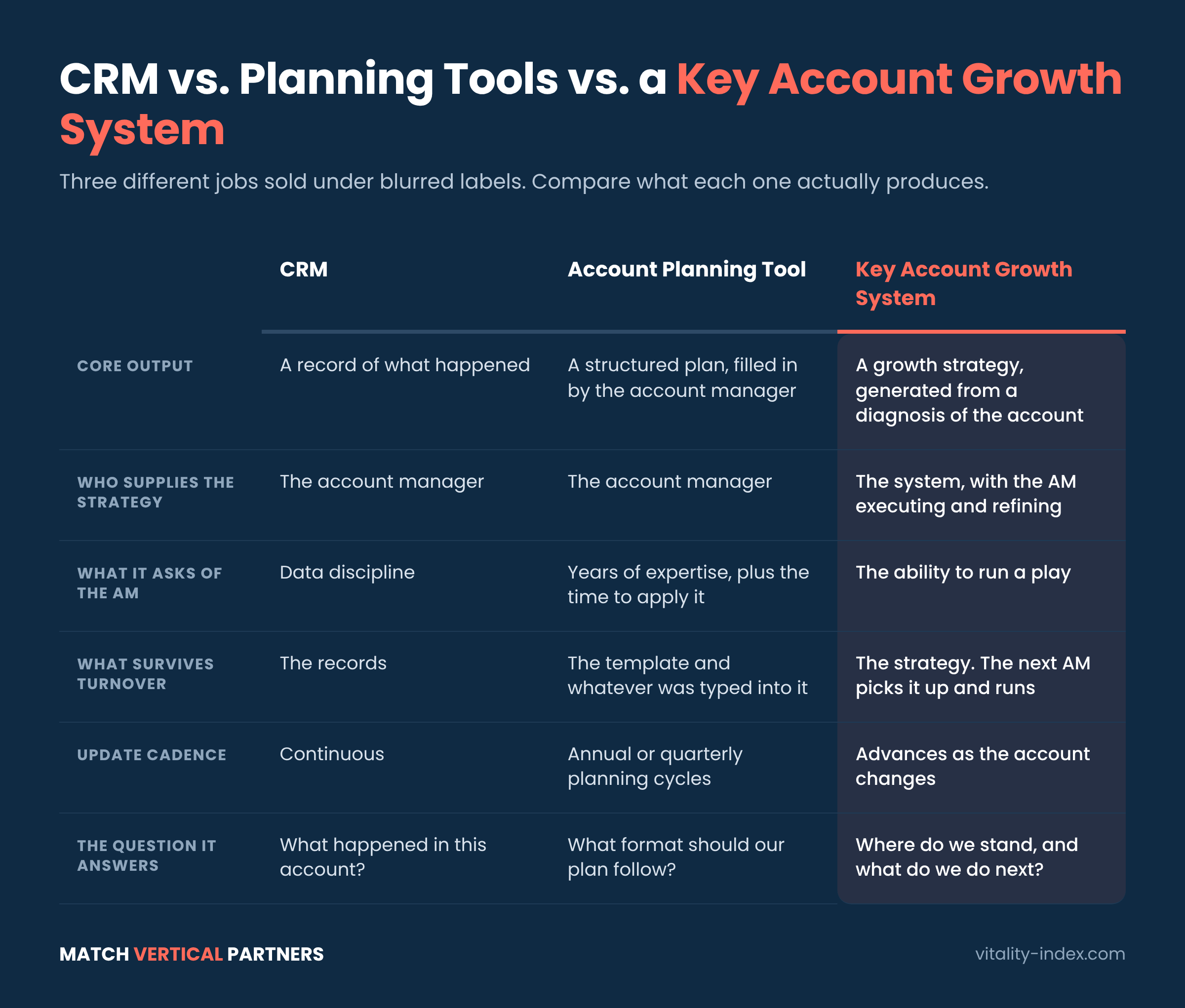
For an accessible, text-based comparison:
- Core output: A CRM produces a record of what happened. An account planning tool produces a structured plan, filled in by the account manager. A key account growth system produces a growth strategy, generated from a diagnosis of the account.
- Who supplies the strategic thinking: With a CRM or account planning tool, the account manager does. With a key account growth system, the system does, with the account manager executing and refining.
- What it asks of the account manager: A CRM asks for data discipline. An account planning tool asks for years of strategy-building expertise, plus the time to apply it. A key account growth system asks for the ability to run a play.
- What survives when the account manager leaves: With a CRM, the records. With an account planning tool, the template and whatever was typed into it. With a key account growth system, the strategy, which the next account manager picks up and runs.
- Update cadence: A CRM is continuous. Account planning tools follow annual or quarterly planning cycles. A key account growth system advances as the account changes in real time.
- The question it answers: A CRM answers "What happened in this account?" An account planning tool answers "What format should our plan follow?" A key account growth system answers "Where does this account stand, and what do we do next?"
All three categories earn a place in a key account operation. They do different jobs, and the costly mistake is buying one category while expecting the output of another.
Is software labeled "KAMS" the same as a key account growth system?
Usually no, and the output test settles it. Ask what the system produces for an account before your team types anything strategic into it. Software in the KAMS market generally produces structure: plan templates, relationship maps, QBR workflows, whitespace grids. Useful structure, and still empty until an account manager with the expertise and the time fills it with a strategy. A growth system produces the strategy itself from a diagnosis of the account. As of this writing, the Vitality Index is the system we know of that works this way, built from 30 years and over $2B in key account revenue, which is why we describe it as its own category rather than a better template.
Why do teams that own good tools still miss their growth targets?
Because records and templates both depend on the account manager to supply the strategy, and building a real growth strategy for every account is a second full-time job nobody was hired to do. The assessment, the competitive analysis, the relationship mapping, the play selection: done well, that work takes days per account. Account managers already have a full-time job taking care of customers and delivering on commitments. So the plans get built in the last 48 hours before the review, the top handful of accounts get real attention, and the rest get last quarter's plan warmed up. Ebsta and Pavilion's 2025 research reports 78% of sellers missing quota. The records in these companies are usually fine. The strategy layer the records were supposed to support is what is missing.
Does a key account growth system replace a CRM or planning tools?
No. When you add the Vitality Index to your sales tech stack, you are adding a strategic layer: the growth strategy that everything else in the stack runs on. Your CRM and planning tools keep doing their jobs, and the growth system guides the others. Think of the account as a vehicle: account management keeps it running, your team drives it, and the growth system is the GPS. It reads where the account stands today, knows the destination, and gives the team the route, turn by turn. A team with records and templates has a well-maintained vehicle. A key account growth system generates the strategy; it is the GPS that routes the trip.
What does "generating the strategy" mean in practice?
It starts with a diagnosis: a structured read of where the account stands across the conditions that decide whether a partnership grows, stalls, or becomes vulnerable. The Vitality Index reads each account across 7 Partnership Domains then produces the growth strategy for that account's position: the plays to run, the next moves, and the coaching to execute them. As plays are completed and conditions inside the account change, the strategy advances with it. The account manager stays the driver. The expertise that took decades to build comes with the system, so a three-year account manager and a twenty-year veteran can now navigate from the same map.
Which one should a key account team buy first?
Buy for the job that is missing. If your team cannot say where each key account stands and what happens next in it, more record-keeping and better templates will not produce that answer, because both wait on the account manager to supply it. Strong key account programs pay: research from the Strategic Account Management Association shows strategic accounts in mature programs growing at roughly twice the rate of non-strategic accounts. The structure behind that growth is the part to buy first.
Frequently asked questions
Does the Vitality Index replace our CRM?
No. It runs alongside your CRM and the rest of your stack. Your tools keep the records, and the Vitality Index gives the account team the growth strategy those tools run on.
Can account planning software generate a strategy?
Planning software structures a plan. The thinking still comes from the account manager, which is why the output quality varies with each person's expertise and available time.
Who on the team uses a key account growth system?
The Vitality Index is ideal for cross functional account teams that need to work from the same strategy. The key account manager uses it to call the next plays for each team member based on where the accounts stand.
How fast does a growth system produce something usable?
The diagnosis is the starting point, and it is fast. The Vitality Index reads one account and produces a growth strategy in minutes. You can test this on one of your own accounts: the free Vitality Snapshot covers 2 of the 7 Partnership Domains at matchvitality.com/assess.
What does a key account growth system cost compared to planning software?
Pricing models differ by vendor and seat count. The comparison worth running first is output per dollar: what each system produces for the money, and how much of your team's time it consumes to produce it.
Ready to compare a key account growth system with your current tools? Schedule a demo.
More in Strategy & Planning
Strategy & Planning
Your key account teams can spend 95% of their time on revenue generating activities with this strategy.
Key account teams lose weeks rebuilding assessments, strategies, and plans every quarter. A consistent system gives every account a tailored growth strategy so teams can spend their time executing it.
Strategy & Planning
Your customer account plans are missing some vital pieces
Account plans go stale because they are snapshots, written in a planning event while the account keeps moving. Reps stop using them because nothing in the daily work ever touches the plan again. Both problems have the same cause: the plan is missing vital pieces. Here are the pieces, and how to put them in.
Strategy & Planning
Why the Hardest-Working Team Doesn't Always Win the Largest Account
The team that loses the account it fought hardest for is rarely outworked. It is out-strategized. The edge the winning team has comes down to one question worth asking long before the account is at stake.
Strategy & Planning
Three Reasons Your Enterprise Account Is Slowly Drifting Off Course
Strategic accounts rarely fail quickly. They drift, quarter by quarter, while the activity logs stay healthy. Three structural reasons drive most of the drift, and none of them are discipline failures. Here is how to spot the drift, why it happens, and how anchoring to a progressive growth strategy keeps you on track to Vital Partnerships.
Strategy & Planning
The Underlying Logic Behind Every B2B Sale Is Still Human Intelligence
Automation, AI, and every tool in your tech stack are only as good as the human intelligence beneath them. Vitality Index was not built from AI. It was built from decades of people working in enterprise sales, building 9-figure portfolios, and learning the patterns that keep showing up.
Strategy & Planning
The Greatest Gift Sales Leadership Can Give a Rep Is Clarity
Most enterprise sales reps walk around in a fog. Not because they lack talent or effort, but because nobody has given them clarity. Clarity of strategy, clarity of plan, and clarity of what to do today. Vitality Index is built to deliver exactly that.
Related across the blog
Key Account Growth
Vitality Index vs Kapta: Which Is Right for Enterprise Sales?
Kapta is a key account management platform with template-driven planning. Vitality Index is a diagnostic engine that measures partnership health and generates a plan from your scores. Here is how to decide which fits your team.
Key Account Growth
Best Enterprise Account Planning Tools in 2026
Enterprise account planning tools range from CRM-native organizers to strategic diagnostic platforms. Here is how the category breaks down and what to look for based on where your team actually needs help.
Key Account Systems
The structure behind growing key accounts in B2B needs changing
Growing key accounts takes more than records and tools. Explore the strategic layer account teams need and the nine standards behind the Vitality Index.
Lead with better systems.
The same frameworks that power this post power Vitality Index - the platform strategic account teams use to measure, plan, and grow their most vital partnerships.