
LinkedIn Posts
One misaligned team member can crash a multimillion-dollar Key Account.

How well are your KAMs leading cross-functional teams they don’t manage?
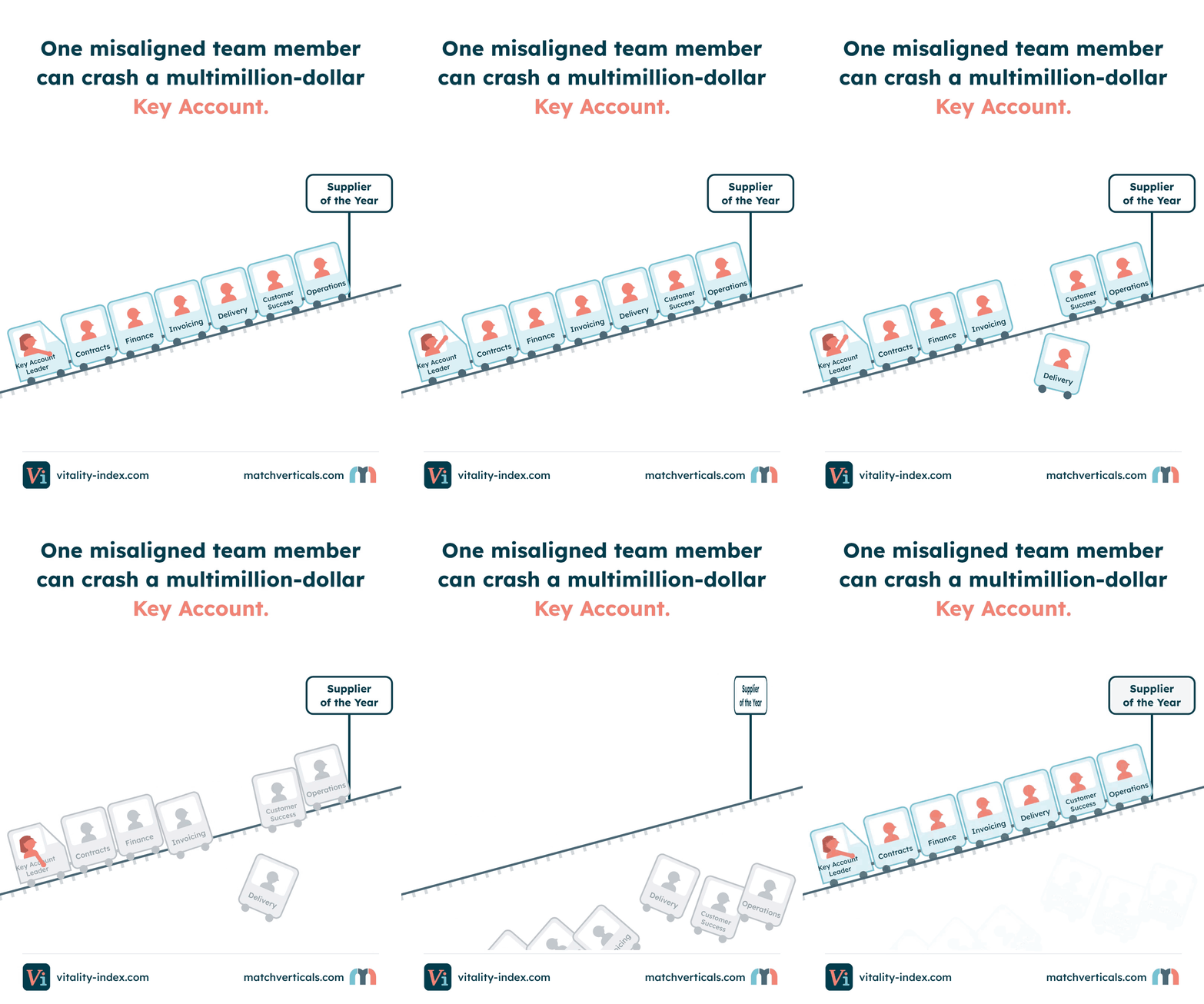
One misaligned team member can crash a multimillion-dollar Key Account.
How well are your KAMs leading cross-functional teams they don’t manage?
We had about 10 people representing six different job functions working a $5M account across several regions. One associate followed a practice from our own sales training. It broke one rule in the client’s 30-page agreement.
The client’s Head of Contracts suspended our services and ordered a full audit. We lost 30% of our revenue with that client, about $1.5M. It took us three months to earn our way back in.
She did exactly what she was trained to do. Nobody had connected her work to what the client cared about.
That job belongs to the Key Account Manager. It’s one of the hardest skills in key account management: leading 5, 20 or even hundreds of people who don’t report to you toward expanding and protecting a large, complex customer.
On another account, I met a three-person team serving the world’s largest life sciences company. Revenue had been flat through several account executives.
We set one mission: become the client’s Supplier of the Year. I invited more than 60 people from departments, functions and experience levels across our company who touched the account to join, and made it optional. Everyone who chose to contribute tested their work against that one unifying objective.
Every quarter, we reviewed our results internally, then asked the client what was still missing. When a gap belonged to one function, the whole team owned it.
Picture being the conductor of a high-speed train that travels cross-country. Every car is coupled to the next, each carrying the function it serves, and the whole train runs on one track to one destination.
In two years, the account grew from $7.8M to $15.6M. We became the top-producing site serving the client, won Supplier of the Year, and became #1 of more than 80 suppliers. (Link to this case study in Comments)
An aligned cross-functional Key Account Team acts in the client’s best interest and yours, whether you’re in the room or not.
To turn your cross-functional team into an effective key account community, start here:
-
Map everyone in your company who touches the account.
-
Set one mission that brings them together, an objective that aligns with what the client cares about and celebrates.
-
Create space for them to generate ideas and solve problems.
-
Seek out opportunities to let their talents surface.
-
Review their progress every quarter, internally and with the client.
-
Ask for feedback on how well you’re doing as their leader, and prioritize ideas that benefit the client first, then the team, then you.
If you want help with this and the other 20 growth drivers that form Vital Partnerships that last, schedule a free 30-minute consultation and ask for a demo of the Vitality Index.
More in LinkedIn Posts
LinkedIn Posts
Account risk stays hidden when Key Account Teams assume the customer trusts them.
You get a confident team and an uncertain customer, and the gap stays invisible until something tests it.
LinkedIn Posts
Competitive advantage erodes when Key Account Teams are disconnected from an overarching growth strategy.
The design of the system the team runs is now the advantage, and the key account role is being rewritten around it.
LinkedIn Posts
If I dropped you somewhere in any one of the 50 states and handed you a map of that state, could you pinpoint where you are without GPS?
A good plan starts from your true position. Can your team say where it stands across every dimension of a key account relationship?
LinkedIn Posts
If you don’t have these 2 things in your key accounts, you could lose millions in revenue.
To become a Vital Partner who can expand and protect your most critical accounts, you need access to the top executive and a champion willing to help you build that relationship.
LinkedIn Posts
Is strategic thinking showing up in your Key Account plans?
Four things every Key Account Team should think about when doing their key account plans: objectives, growth strategy, actions and timelines.
LinkedIn Posts
When someone leaves your Key Account Team, how much of the account walks out the door with them?
If the knowledge of how your team solves problems lives in one or two people’s heads, the account is one resignation away from starting over.
Related across the blog
Strategy & Planning
CRM vs. Account Planning Tools vs. a Key Account Growth System: What Each One Does
A CRM keeps the records. Account planning tools structure the plan your team fills in. A key account growth system generates the strategy itself. Here is the difference, side by side.
Key Account Systems
The structure behind growing key accounts in B2B needs changing
Growing key accounts takes more than records and tools. Explore the strategic layer account teams need and the nine standards behind the Vitality Index.
Key Account Growth
You just won a massive key account. Now what?
Winning a massive key account is only the start. The real work is building a partnership that can withstand renewals, competitive threats, and growth across the business.
Lead with better systems.
The same frameworks that power this post power Vitality Index - the platform strategic account teams use to measure, plan, and grow their most vital partnerships.