
LinkedIn Posts
I need my team to act on warning signs at my key account before they turn into losses.

Warning signs often show up early: a number that slips, a meeting that gets pushed, a champion who goes quiet.
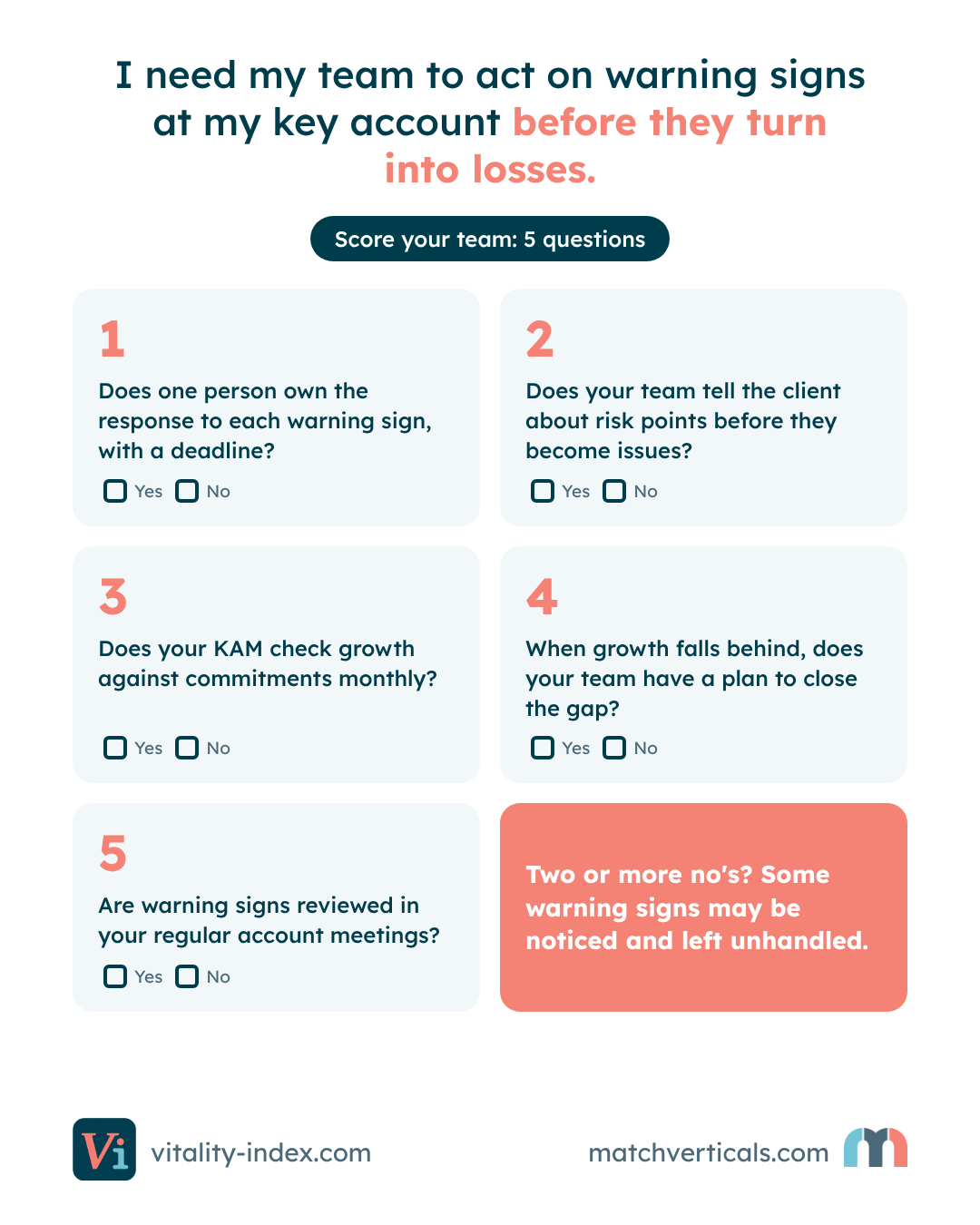
I need my team to act on warning signs at my key account before they turn into losses.
Warning signs often show up early: a number that slips, a meeting that gets pushed, a champion who goes quiet. A sign helps only when someone owns the response.
Five questions to see if your team can do this job today:
- Does one person own the response to each warning sign, with a deadline?
- Does your team tell the client about risk points before they become issues?
- Does your key account manager (KAM) check growth against commitments monthly?
- When growth falls behind, does your team have a plan to close the gap?
- Are warning signs reviewed in your regular account meetings?
Two or more no's, and some warning signs may be noticed and left unhandled.
Whenever a customer goes quiet, we make sure our teams feel a healthy level of insecurity. We want them to explore the relationship from different angles so they can find the missing piece, if there is one.
On one occasion, one of our key accounts went silent. We went to three different champions and an executive to find out what was going on. They dismissed our concerns, said everything was okay, and told us orders had slowed down but they expected that to change in the near future.
We didn't accept that answer, partly because we've heard that exact speech many times, and it's almost never true. So we asked a different way: "Is there anything you're dealing with that's outside our ability to solve but could impact the partnership?"
The answer was yes. They were dealing with a massive legal challenge they could not disclose on the advice of their lawyers, and the board had put a temporary hold on spending until the matter was resolved. We later learned they were in serious trouble because of misdealings by one of their executives.
The good news is that we saw the warning signs and acted. Our instincts were right. We knew with certainty that we couldn't help them with the challenge that caused the relationship to go quiet, but when things changed, we would be in position to support them.
Sometimes that's just enough empathy for your client to protect the relationship.
We're not order takers at this level of partnership. We're key partners they depend on to get work done well. In this case, that meant keeping steady, staying in position and being ready for when the customer surfaced again and needed our help.
A quiet customer is a signal worth chasing. Your team can ask the question from more than one angle until the real answer comes out.
Our system, the Vitality Index, shows your key account teams where they stand today, the work it takes to level up, and how to do it, until they reach a vital partnership that lasts.
Which key account has gone quiet, and who knows why?
We built a free, 4-minute Key Account Risk Assessment. It gives you a risk score for your key accounts across team alignment, account planning, account transitions, and visibility. Link in the comments.
More in LinkedIn Posts
LinkedIn Posts
Would my champion in our key account be proud to forward our results to their boss?
A champion forwards what makes them look good to their boss and poses no risk of hurting their brand.
LinkedIn Posts
I need my partners and sub-vendors running the same strategy for my key account that we are.
Partners and sub-vendors shape how the client experiences your team.
LinkedIn Posts
I need proof of what we deliver for my key account, captured while we deliver it.
When the client asks what you've done for them, the answer needs numbers in their language.
LinkedIn Posts
I need sales and delivery to turn their disagreements into progress on my key account.
Sales and delivery often disagree on how to approach the work in key accounts that are growing.
LinkedIn Posts
I need someone on my team who could run my key account tomorrow.
In key account management, it's critical to have a succession plan.
LinkedIn Posts
I need the people touching my key account to pull in the same direction.
Your key account depends on sales, delivery, finance, contracts and maybe sub vendors, and few of them report to you.
Related across the blog
Strategy & Planning
CRM vs. Account Planning Tools vs. a Key Account Growth System: What Each One Does
A CRM keeps the records. Account planning tools structure the plan your team fills in. A key account growth system generates the strategy itself. Here is the difference, side by side.
Key Account Systems
The structure behind growing key accounts in B2B needs changing
Growing key accounts takes more than records and tools. Explore the strategic layer account teams need and the nine standards behind the Vitality Index.
Key Account Growth
You just won a massive key account. Now what?
Winning a massive key account is only the start. The real work is building a partnership that can withstand renewals, competitive threats, and growth across the business.
Lead with better systems.
The same frameworks that power this post power Vitality Index - the platform strategic account teams use to measure, plan, and grow their most vital partnerships.