
LinkedIn Posts
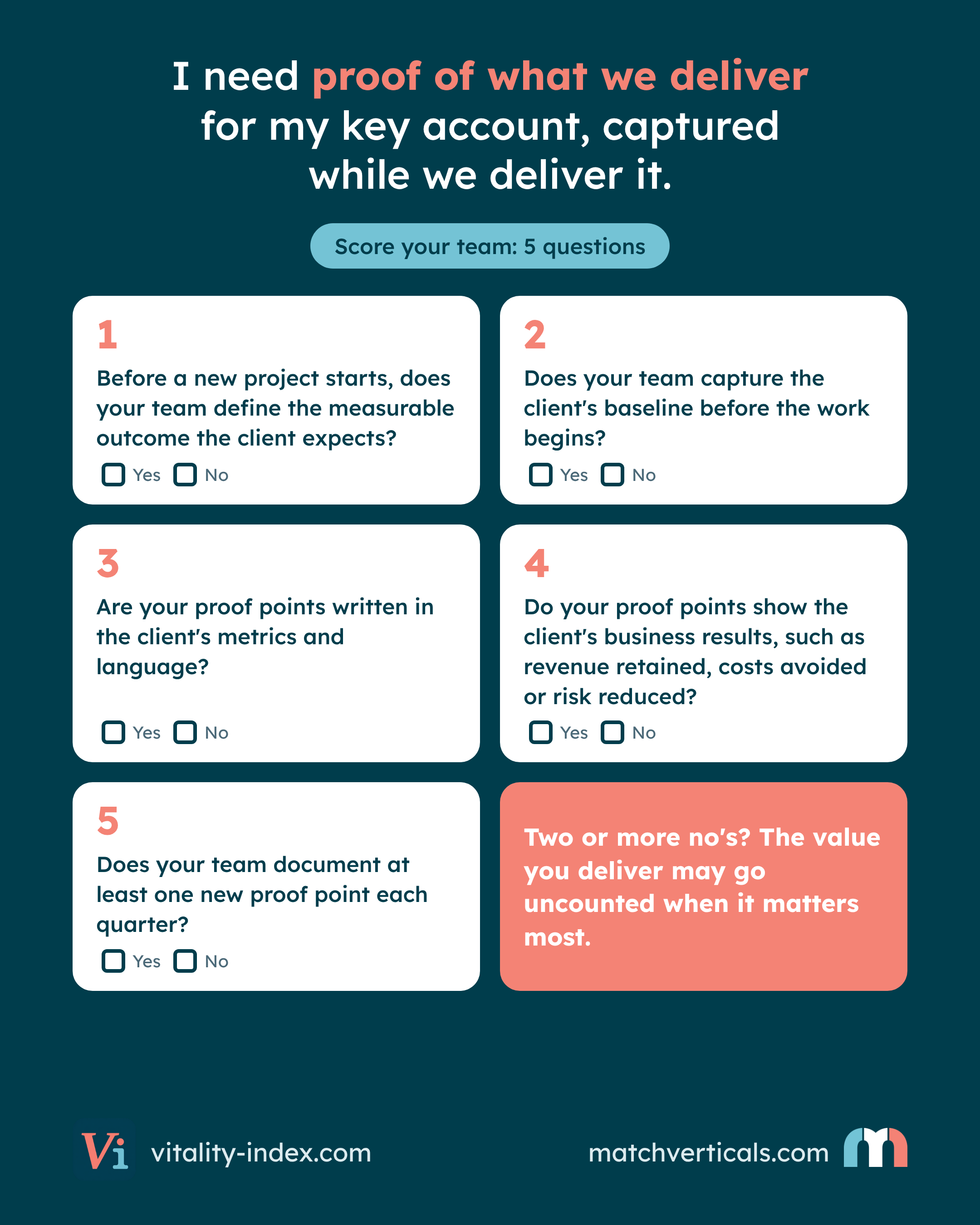
I need proof of what we deliver for my key account, captured while we deliver it.

When the client asks what you've done for them, the answer needs numbers in their language.
I need proof of what we deliver for my key account, captured while we deliver it.
When the client asks what you've done for them, the answer needs numbers in their language. That proof is easiest to capture while the work is happening, with a clear before and after.
Five questions to see if your team can do this job today:
- Before a new project starts, does your team define the measurable outcome the client expects?
- Does your team capture the client's baseline before the work begins?
- Are your proof points written in the client's metrics and language?
- Do your proof points show the client's business results, such as revenue retained, costs avoided or risk reduced?
- Does your team document at least one new proof point each quarter?
Two or more no's, and the value you deliver may go uncounted when it matters most.
One of my largest accounts was behind in key performance metrics with several of their customers. If one of their projects was behind by one day, the estimated direct cost was $55K per day, plus another $800K per day in lost revenue. So, close to $1M every day in losses. The issue was not tied to our services. This was truly a performance issue our client was facing.
We met with them, learned the root cause of the issue, and determined how to solve it. Here are the details.
Challenge: The client was behind on delivery of service by an average of 30 days across multiple projects in a key performance area. Result: $30M in lost revenue and direct costs. Client Metric: Achieve 95% on-time delivery every 5 days. Outcome: We co-developed an immediate solution that brought the client back to delivering 95% every 5 days. Proof Point: The solution helped them retain several key customer projects that averaged $10M each.
This was objective evidence of actual value communicated using the customer's metrics, their language, and their point of view. This client would go on to be a Vital Partnership that has lasted 20+ years.
If your success doesn't point to their success, then it's not a Proof Point.
Our system, the Vitality Index, shows your key account teams where they stand today, the work it takes to level up, and how to do it, until they reach a vital partnership that lasts.
If your key account asked what you delivered for them this quarter, what number would you show?
We built a free, 4-minute Key Account Risk Assessment. It gives you a risk score for your key accounts across team alignment, account planning, account transitions, and visibility. Link in the comments.
More in LinkedIn Posts
LinkedIn Posts
Would my champion in our key account be proud to forward our results to their boss?
A champion forwards what makes them look good to their boss and poses no risk of hurting their brand.
LinkedIn Posts
I need my partners and sub-vendors running the same strategy for my key account that we are.
Partners and sub-vendors shape how the client experiences your team.
LinkedIn Posts
I need my team to act on warning signs at my key account before they turn into losses.
Warning signs often show up early: a number that slips, a meeting that gets pushed, a champion who goes quiet.
LinkedIn Posts
I need sales and delivery to turn their disagreements into progress on my key account.
Sales and delivery often disagree on how to approach the work in key accounts that are growing.
LinkedIn Posts
I need someone on my team who could run my key account tomorrow.
In key account management, it's critical to have a succession plan.
LinkedIn Posts
I need the people touching my key account to pull in the same direction.
Your key account depends on sales, delivery, finance, contracts and maybe sub vendors, and few of them report to you.
Related across the blog
Strategy & Planning
CRM vs. Account Planning Tools vs. a Key Account Growth System: What Each One Does
A CRM keeps the records. Account planning tools structure the plan your team fills in. A key account growth system generates the strategy itself. Here is the difference, side by side.
Key Account Systems
The structure behind growing key accounts in B2B needs changing
Growing key accounts takes more than records and tools. Explore the strategic layer account teams need and the nine standards behind the Vitality Index.
Key Account Growth
You just won a massive key account. Now what?
Winning a massive key account is only the start. The real work is building a partnership that can withstand renewals, competitive threats, and growth across the business.
Lead with better systems.
The same frameworks that power this post power Vitality Index - the platform strategic account teams use to measure, plan, and grow their most vital partnerships.