
LinkedIn Posts
How does my key account measure what we're worth?

Most customers keep a scorecard for their vendors, written down or not.
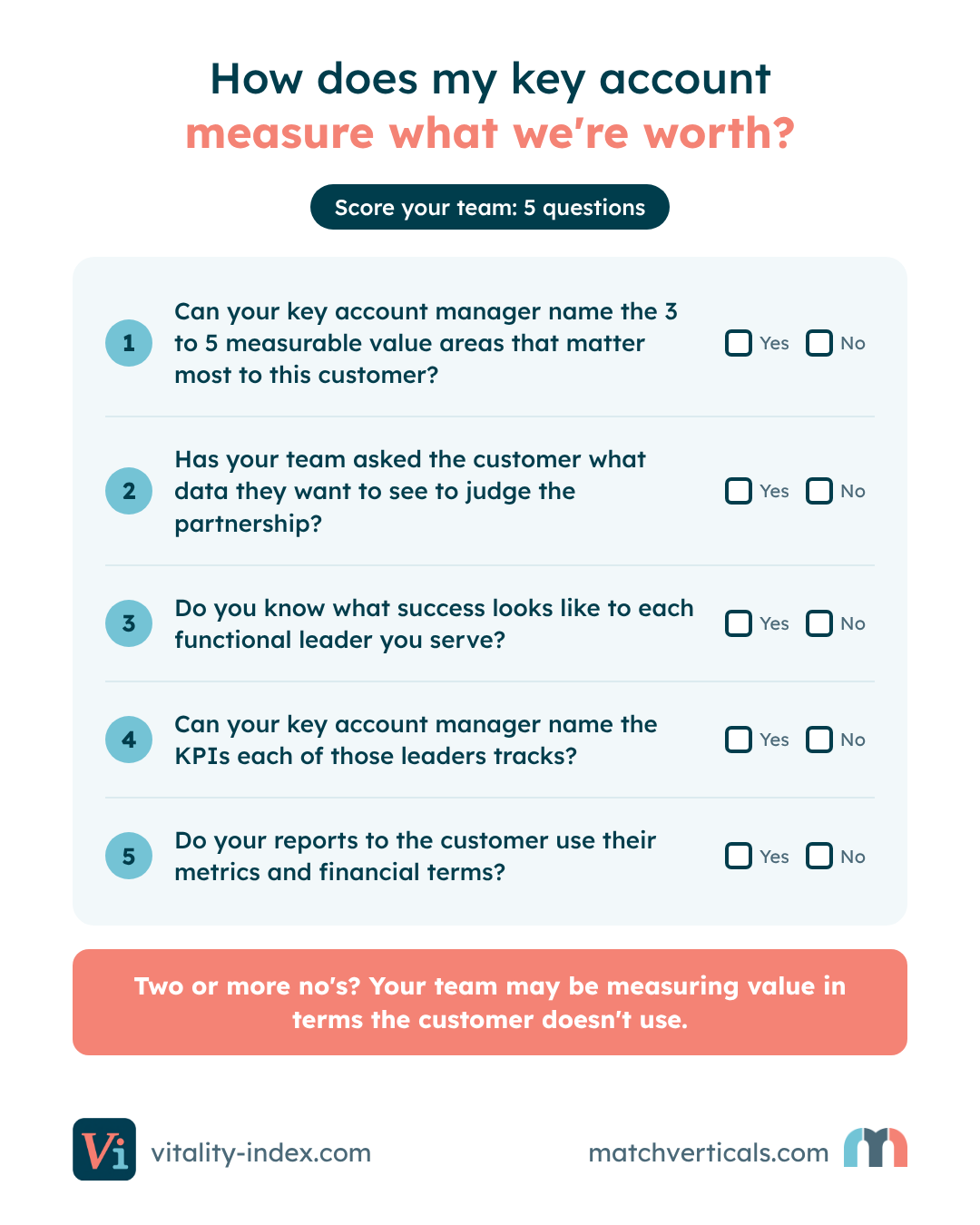
How does my key account measure what we're worth?
Most customers keep a scorecard for their vendors, written down or not. A key account manager who knows what's on it, in the customer's own metrics and financial terms, can show value the customer recognizes.
Five questions to see if your team can do this job today:
- Can your key account manager name the 3 to 5 measurable value areas that matter most to this customer?
- Has your team asked the customer what data they want to see to judge the partnership?
- Do you know what success looks like to each functional leader you serve?
- Can your key account manager name the KPIs each of those leaders tracks?
- Do your reports to the customer use their metrics and financial terms?
Two or more no's, and your team may be measuring value in terms the customer doesn't use.
Early in our careers, we reported to the customer mostly on how many orders we filled and our spend. The client was measuring one thing: how many projects they could start and finish on time and under budget. We were not speaking their language.
We have three rules we strive to keep in B2B sales:
- Make sure we're dealing with the right ICP (ideal customer persona).
- Find out what our ICP really cares about.
- Build solutions around what they care about.
In this example, that was not happening.
Once we knew what they measured, we did some self-reflection to see how we could report on what they cared about. We took a few recent projects and started asking for more details around time and cost. We found out the customer was in a lot of pain here. They were about three months behind in starting every project, which put them way over budget.
With rule #2 established, we worked on #3. We found a solution that was perfect for solving the customer's problem, and it generated 2X more business for us. We installed a quarterback who could manage everything that had to be done to get a project off the ground. It turned out most of that work was on the client side, so our person helped them get stronger at managing time and cost. That opened up more projects and the need for more of our services.
It was a win-win in the end. That solution would never have come about by measuring our internal KPIs. Only when we learned their KPIs could we build the right solution and track how we were impacting their business success.
Our system, the Vitality Index, shows your key account teams where they stand today, the work it takes to level up, and how to do it, until they reach a vital partnership that lasts.
What metric does your largest customer use to judge your team?
We built a free, 4-minute Key Account Risk Assessment. It gives you a risk score for your key accounts across team alignment, account planning, account transitions, and visibility. Link in the comments.
More in LinkedIn Posts
LinkedIn Posts
Would my champion in our key account be proud to forward our results to their boss?
A champion forwards what makes them look good to their boss and poses no risk of hurting their brand.
LinkedIn Posts
I need my partners and sub-vendors running the same strategy for my key account that we are.
Partners and sub-vendors shape how the client experiences your team.
LinkedIn Posts
I need my team to act on warning signs at my key account before they turn into losses.
Warning signs often show up early: a number that slips, a meeting that gets pushed, a champion who goes quiet.
LinkedIn Posts
I need proof of what we deliver for my key account, captured while we deliver it.
When the client asks what you've done for them, the answer needs numbers in their language.
LinkedIn Posts
I need sales and delivery to turn their disagreements into progress on my key account.
Sales and delivery often disagree on how to approach the work in key accounts that are growing.
LinkedIn Posts
I need someone on my team who could run my key account tomorrow.
In key account management, it's critical to have a succession plan.
Related across the blog
Strategy & Planning
CRM vs. Account Planning Tools vs. a Key Account Growth System: What Each One Does
A CRM keeps the records. Account planning tools structure the plan your team fills in. A key account growth system generates the strategy itself. Here is the difference, side by side.
Key Account Systems
The structure behind growing key accounts in B2B needs changing
Growing key accounts takes more than records and tools. Explore the strategic layer account teams need and the nine standards behind the Vitality Index.
Key Account Growth
You just won a massive key account. Now what?
Winning a massive key account is only the start. The real work is building a partnership that can withstand renewals, competitive threats, and growth across the business.
Lead with better systems.
The same frameworks that power this post power Vitality Index - the platform strategic account teams use to measure, plan, and grow their most vital partnerships.