
LinkedIn Posts
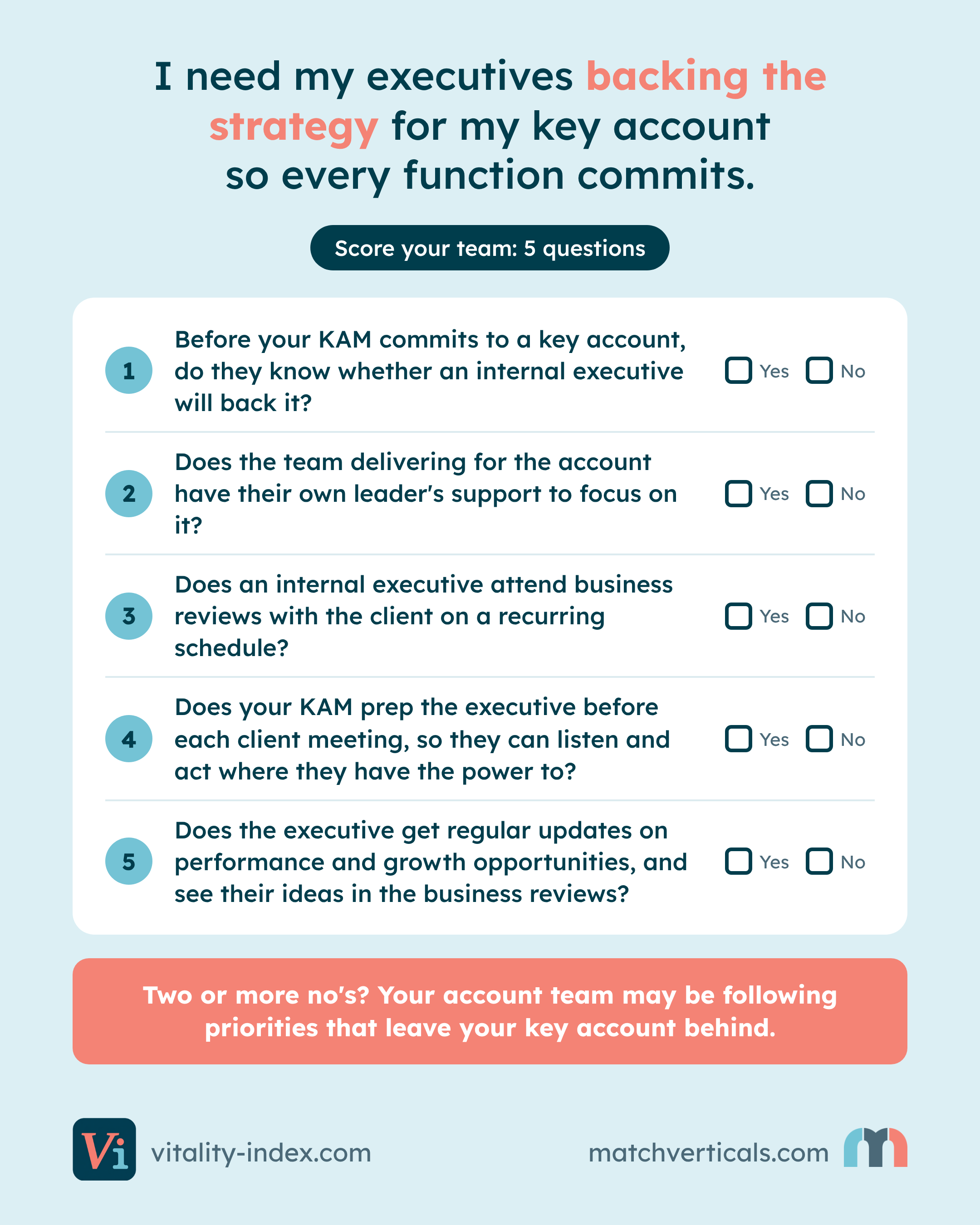
I need my executives backing the strategy for my key account so every function commits.

The people who deliver for your key account follow the priorities of the leader they report to.
I need my executives backing the strategy for my key account so every function commits.
The people who deliver for your key account follow the priorities of the leader they report to. When that leader backs the account, people, roles and budget follow.
Five questions to see if your team can do this job today:
- Before your key account manager (KAM) commits to a key account, do they know whether an internal executive will back it?
- Does the team delivering for the account have their own leader's support to focus on it?
- Does an internal executive attend business reviews with the client on a recurring schedule?
- Does your KAM prep the executive before each client meeting, so they can listen and act where they have the power to?
- Does the executive get regular updates on performance and growth opportunities, and see their ideas in the business reviews?
Two or more no's, and your account team may be following priorities that leave your key account behind.
When I was a strategic account executive, my formula for choosing which national accounts to target was simple. Do we have an internal executive committed to growing the account? Do we have at least one active site to anchor the account team? Does the account have upside?
That year, I found a large biotech firm that fit perfectly. We were active in one location out of 10, and a regional vice president (RVP) sat in the branch next to the customer's HQ.
I asked the local account team why they weren't focused on growing this account. They said their regional leader directed them to business that moved faster, with better margins and less competition. That afternoon, the RVP gave me the same answers. Then I asked him to attend a business review with the client the next day, and he agreed.
From there, I connected him with the client's key stakeholders, set a one-hour meeting with the client each quarter, and prepped him before each one so he could listen and contribute where he had the power to act. Between meetings, I gave him a steady diet of performance metrics, account updates and growth opportunities, and built his suggestions into every business review.
As he became more engaged, he added team members dedicated to the account, created new roles to improve delivery, and championed the account with the other RVPs. Revenue doubled each year for three years. We went from one location to all 10, surpassed every vendor in a $45M program, and were awarded Supplier of the Year.
Our system, the Vitality Index, shows your key account teams where they stand today, the work it takes to level up, and how to do it, until they reach a vital partnership that lasts.
Which internal executive would you invite to your key account's next business review?
We built a free, 4-minute Key Account Risk Assessment. It gives you a risk score for your key accounts across team alignment, account planning, account transitions, and visibility. Link in the comments.
More in LinkedIn Posts
LinkedIn Posts
Would my champion in our key account be proud to forward our results to their boss?
A champion forwards what makes them look good to their boss and poses no risk of hurting their brand.
LinkedIn Posts
I need my partners and sub-vendors running the same strategy for my key account that we are.
Partners and sub-vendors shape how the client experiences your team.
LinkedIn Posts
I need my team to act on warning signs at my key account before they turn into losses.
Warning signs often show up early: a number that slips, a meeting that gets pushed, a champion who goes quiet.
LinkedIn Posts
I need proof of what we deliver for my key account, captured while we deliver it.
When the client asks what you've done for them, the answer needs numbers in their language.
LinkedIn Posts
I need sales and delivery to turn their disagreements into progress on my key account.
Sales and delivery often disagree on how to approach the work in key accounts that are growing.
LinkedIn Posts
I need someone on my team who could run my key account tomorrow.
In key account management, it's critical to have a succession plan.
Related across the blog
Strategy & Planning
CRM vs. Account Planning Tools vs. a Key Account Growth System: What Each One Does
A CRM keeps the records. Account planning tools structure the plan your team fills in. A key account growth system generates the strategy itself. Here is the difference, side by side.
Key Account Systems
The structure behind growing key accounts in B2B needs changing
Growing key accounts takes more than records and tools. Explore the strategic layer account teams need and the nine standards behind the Vitality Index.
Key Account Growth
You just won a massive key account. Now what?
Winning a massive key account is only the start. The real work is building a partnership that can withstand renewals, competitive threats, and growth across the business.
Lead with better systems.
The same frameworks that power this post power Vitality Index - the platform strategic account teams use to measure, plan, and grow their most vital partnerships.