
LinkedIn Posts
I need to see how a change in one part of my key account ripples through the rest.

A key account is a set of connected parts.
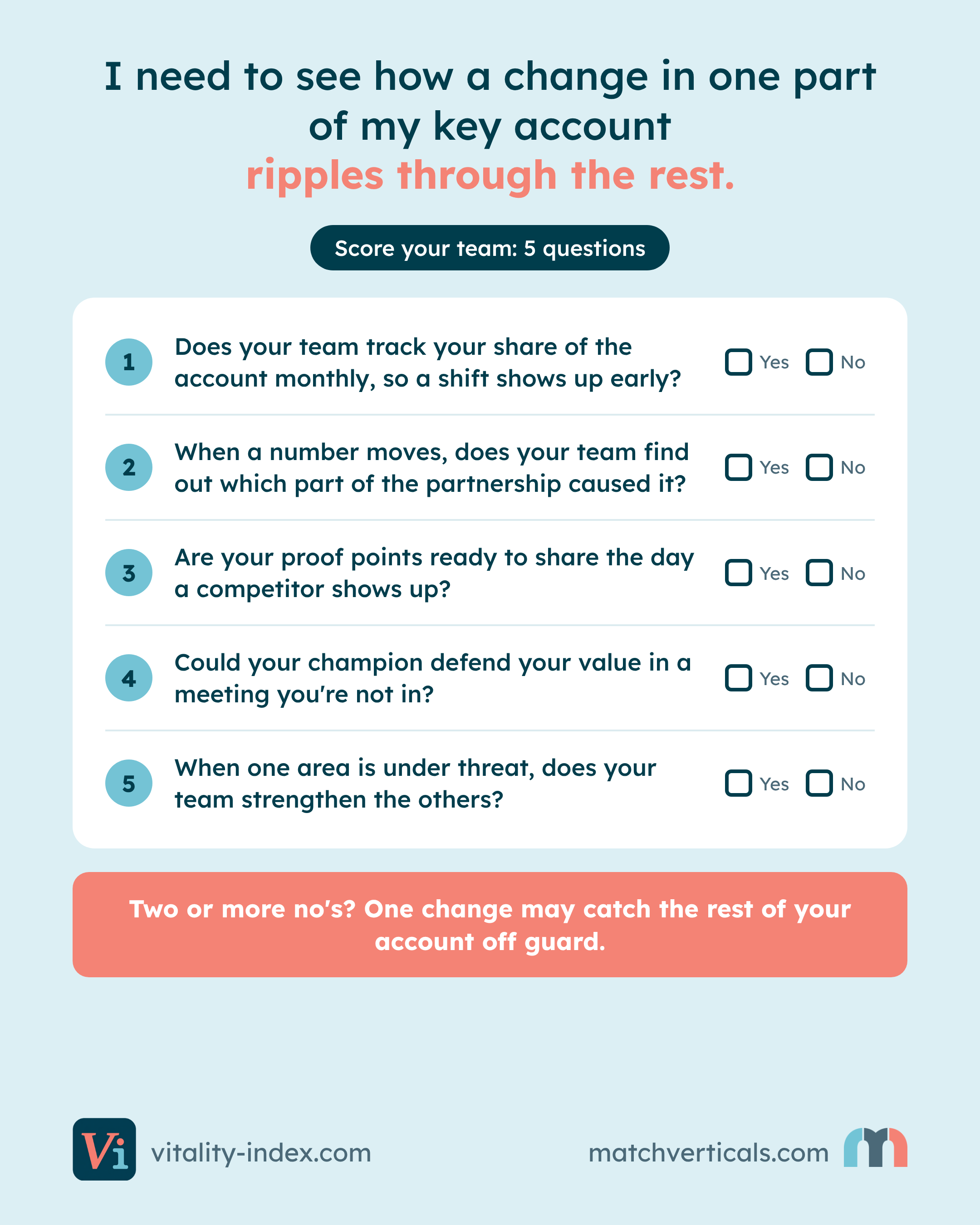
I need to see how a change in one part of my key account ripples through the rest.
A key account is a set of connected parts. Relationships, competitive position, expansion, pricing and business reviews move together, so a change in one ripples into the others. Teams that see those connections can respond across the whole account.
Five questions to see if your team can do this job today:
- Does your team track your share of the account monthly, so a shift shows up early?
- When a number moves, does your team find out which part of the partnership caused it?
- Are your proof points ready to share the day a competitor shows up?
- Could your champion defend your value in a meeting you're not in?
- When one area is under threat, does your team strengthen the others?
Two or more no's, and a change in one part of your account may catch the rest of it off guard.
We had grown to roughly $10M a year inside a large institution. Then a threat arrived from a direction we couldn't have anticipated. A member of the institution's board had a personal relationship with the owner of a competing firm. That competitor started receiving opportunities that had previously come to us. We didn't have access to the board. We couldn't fight the threat at the source. We had to fight it everywhere else.
We tracked our revenue share monthly and noticed the decline before it became significant. We met with our champion and asked directly what had changed. She told us, and she was frustrated, because she knew what we delivered.
We compiled every proof point, performance metric and NPS score into a format our champion could share with her leadership. Then we walked her through our value proposition and differentiators and gave her the words to use in meetings we would never be invited to.
We went on offense from a defensive position. We introduced new capabilities before the client asked for them. We expanded into departments where we had no presence, so the competitor couldn't gain traction in unoccupied areas. We refreshed our pricing to reflect the long-term partnership value. And we made sure our enterprise-level outcomes were presented at every quarterly business review. Competitors win in the shadows. We kept the lights on.
We held our market share. The competitor gained a small foothold, but we contained it. The threat made our partnership stronger, because our champion understood our value more deeply after she had to defend it.
Our system, the Vitality Index, shows your key account teams where they stand today, the work it takes to level up, and how to do it, until they reach a vital partnership that lasts.
If one relationship changed in your key account tomorrow, which other parts would feel it first?
We built a free, 4-minute Key Account Risk Assessment. It gives you a risk score for your key accounts across team alignment, account planning, account transitions, and visibility. Link in the comments.
More in LinkedIn Posts
LinkedIn Posts
Would my champion in our key account be proud to forward our results to their boss?
A champion forwards what makes them look good to their boss and poses no risk of hurting their brand.
LinkedIn Posts
I need my partners and sub-vendors running the same strategy for my key account that we are.
Partners and sub-vendors shape how the client experiences your team.
LinkedIn Posts
I need my team to act on warning signs at my key account before they turn into losses.
Warning signs often show up early: a number that slips, a meeting that gets pushed, a champion who goes quiet.
LinkedIn Posts
I need proof of what we deliver for my key account, captured while we deliver it.
When the client asks what you've done for them, the answer needs numbers in their language.
LinkedIn Posts
I need sales and delivery to turn their disagreements into progress on my key account.
Sales and delivery often disagree on how to approach the work in key accounts that are growing.
LinkedIn Posts
I need someone on my team who could run my key account tomorrow.
In key account management, it's critical to have a succession plan.
Related across the blog
Strategy & Planning
CRM vs. Account Planning Tools vs. a Key Account Growth System: What Each One Does
A CRM keeps the records. Account planning tools structure the plan your team fills in. A key account growth system generates the strategy itself. Here is the difference, side by side.
Key Account Systems
The structure behind growing key accounts in B2B needs changing
Growing key accounts takes more than records and tools. Explore the strategic layer account teams need and the nine standards behind the Vitality Index.
Key Account Growth
You just won a massive key account. Now what?
Winning a massive key account is only the start. The real work is building a partnership that can withstand renewals, competitive threats, and growth across the business.
Lead with better systems.
The same frameworks that power this post power Vitality Index - the platform strategic account teams use to measure, plan, and grow their most vital partnerships.