
LinkedIn Posts
If my key account's CFO asked what we're worth in dollars, what would we say?

A result becomes a number a CFO can use when it's stated in dollars: what it earned, saved or protected, and what that's worth over a year.
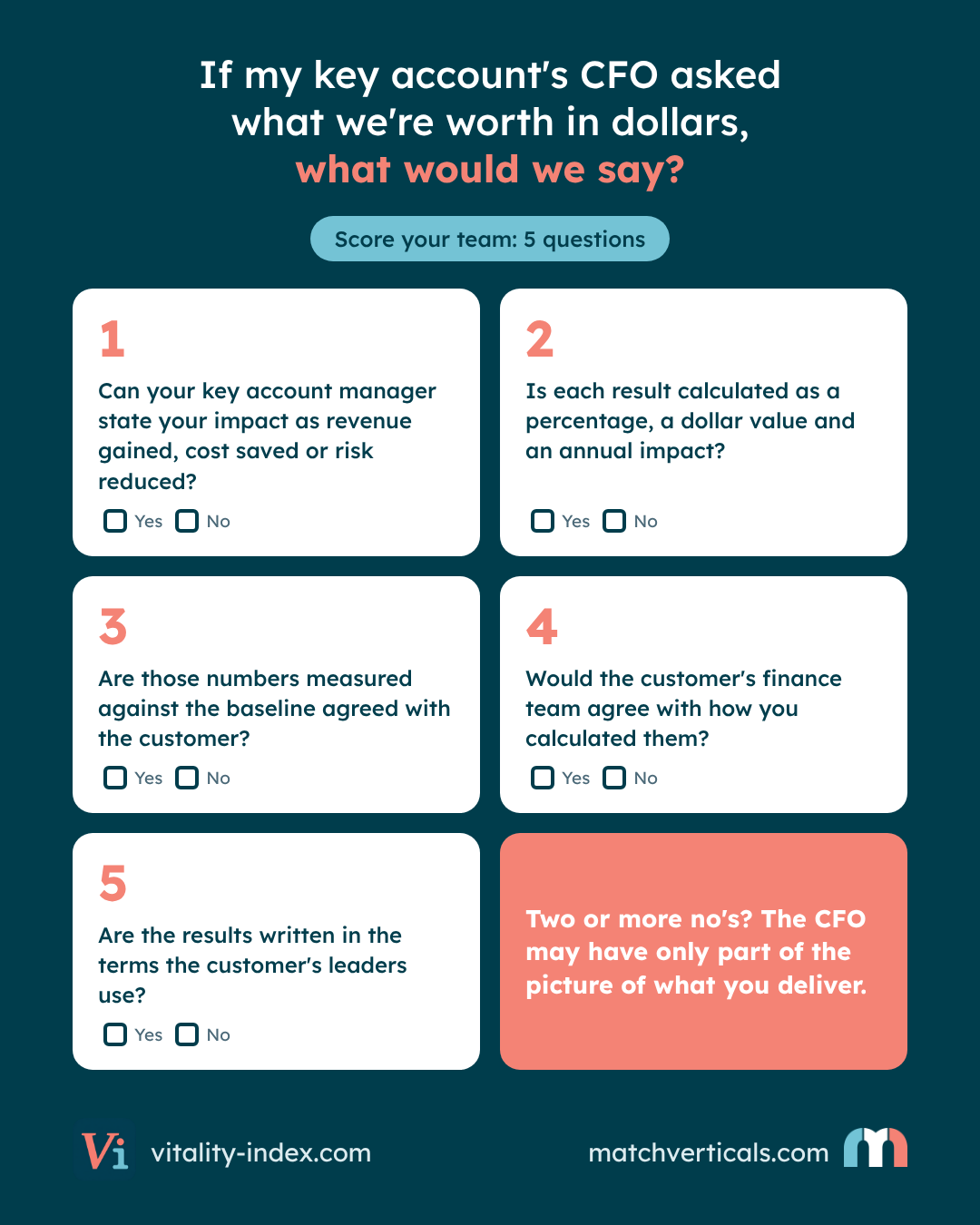
If my key account's CFO asked what we're worth in dollars, what would we say?
A result becomes a number a CFO can use when it's stated in dollars: what it earned, saved or protected, and what that's worth over a year. Stated in the customer's own terms, it needs no translation.
Five questions to see if your team can do this job today:
- Can your KAM state your impact as revenue gained, cost saved or risk reduced?
- Is each result calculated as a percentage, a dollar value and an annual impact?
- Are those numbers measured against the baseline you agreed on with the customer?
- Would the customer's finance team agree with how you calculated them?
- Are the results written in the terms the customer's leaders use?
Two or more no's, and the CFO may have only part of the picture of what you deliver.
We had a key account leader who didn't think we were any different from the other seven vendors on her list. She also had no formal way of measuring the total value of each vendor. That was our third question in our first meeting: "How do you know if your vendors give you a return on investment?" She said, "We don't. We just measure their delivery against what they agreed to." We said, "So that's compliance, and it matters, but ROI is different."
After that meeting, we followed up with three of her success metrics that she agreed were critical to her success and would be a good way to measure our ROI. They had to do with efficiency, capacity and capabilities. We used her terms to describe them and agreed on how and when they would be measured. She measured the other vendors against the same standards, and now we all had an objective lens she could use to tell a good partner from a vital partner.
In the end, it was clear we had saved her millions and earned her millions in new projects. We increased her efficiency, capacity and capabilities, and we could prove it.
The proof came from her metrics, measured her way. Your team can start with the same question we asked: "How do you know if your vendors give you a return on investment?"
Our system, the Vitality Index, shows your key account teams where they stand today, the work it takes to level up, and how to do it, until they reach a vital partnership that lasts.
What is your team worth to your largest customer, in dollars, this year?
We built a free, 4-minute Key Account Risk Assessment. It gives you a risk score for your key accounts across team alignment, account planning, account transitions, and visibility. Link in the comments.
More in LinkedIn Posts
LinkedIn Posts
Would my champion in our key account be proud to forward our results to their boss?
A champion forwards what makes them look good to their boss and poses no risk of hurting their brand.
LinkedIn Posts
I need my partners and sub-vendors running the same strategy for my key account that we are.
Partners and sub-vendors shape how the client experiences your team.
LinkedIn Posts
I need my team to act on warning signs at my key account before they turn into losses.
Warning signs often show up early: a number that slips, a meeting that gets pushed, a champion who goes quiet.
LinkedIn Posts
I need proof of what we deliver for my key account, captured while we deliver it.
When the client asks what you've done for them, the answer needs numbers in their language.
LinkedIn Posts
I need sales and delivery to turn their disagreements into progress on my key account.
Sales and delivery often disagree on how to approach the work in key accounts that are growing.
LinkedIn Posts
I need someone on my team who could run my key account tomorrow.
In key account management, it's critical to have a succession plan.
Related across the blog
Strategy & Planning
CRM vs. Account Planning Tools vs. a Key Account Growth System: What Each One Does
A CRM keeps the records. Account planning tools structure the plan your team fills in. A key account growth system generates the strategy itself. Here is the difference, side by side.
Key Account Systems
The structure behind growing key accounts in B2B needs changing
Growing key accounts takes more than records and tools. Explore the strategic layer account teams need and the nine standards behind the Vitality Index.
Key Account Growth
You just won a massive key account. Now what?
Winning a massive key account is only the start. The real work is building a partnership that can withstand renewals, competitive threats, and growth across the business.
Lead with better systems.
The same frameworks that power this post power Vitality Index - the platform strategic account teams use to measure, plan, and grow their most vital partnerships.