
LinkedIn Posts
Our dashboard says my key account is healthy. Is it?

If you lead key accounts, you've likely had this thought when the numbers look fine and something still feels off.
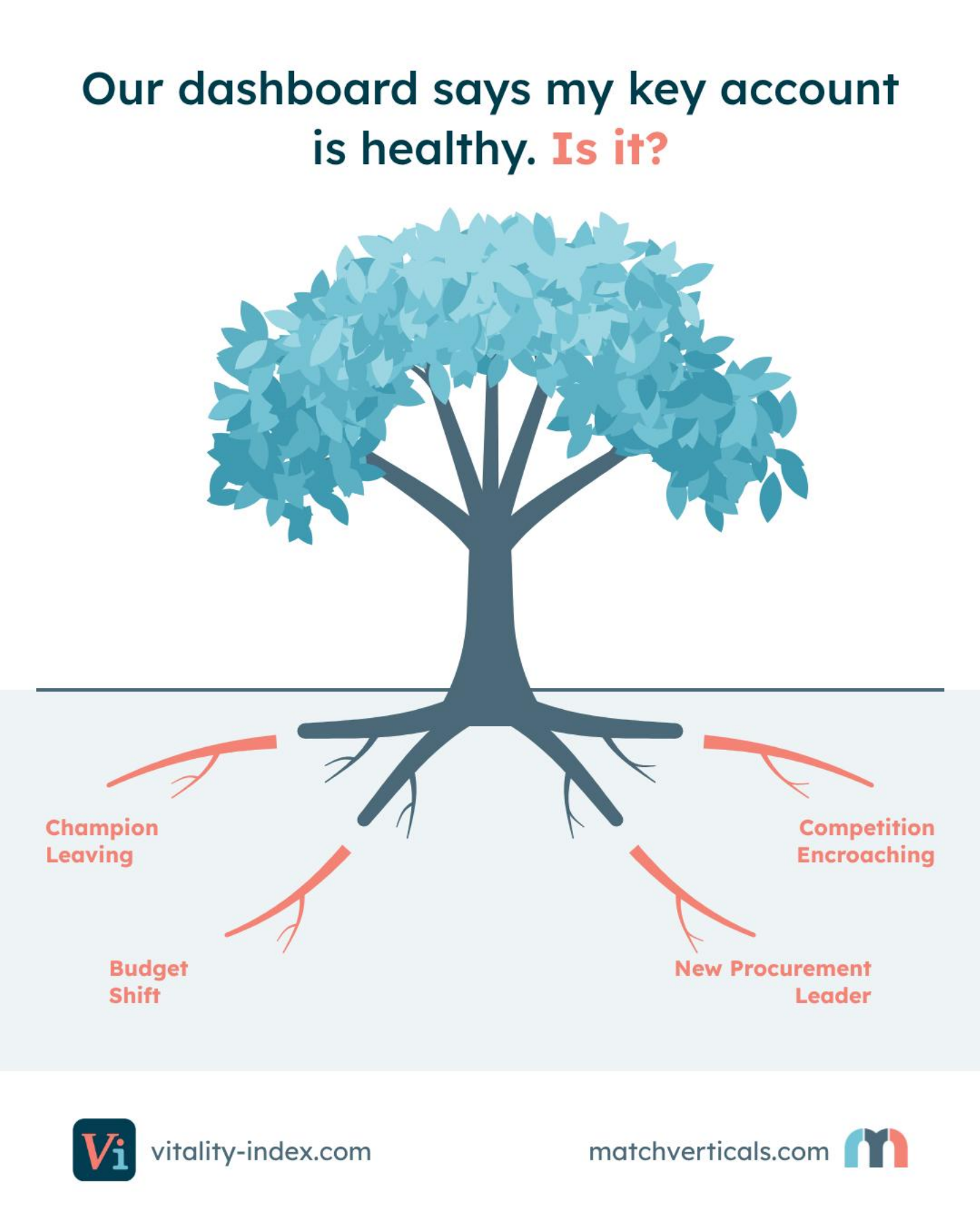
Our dashboard says my key account is healthy. Is it?
If you lead key accounts, you've likely had this thought when the numbers look fine and something still feels off. A dashboard shows what already happened. A true read on the account comes from the people, the patterns and the knowledge your team holds about it.
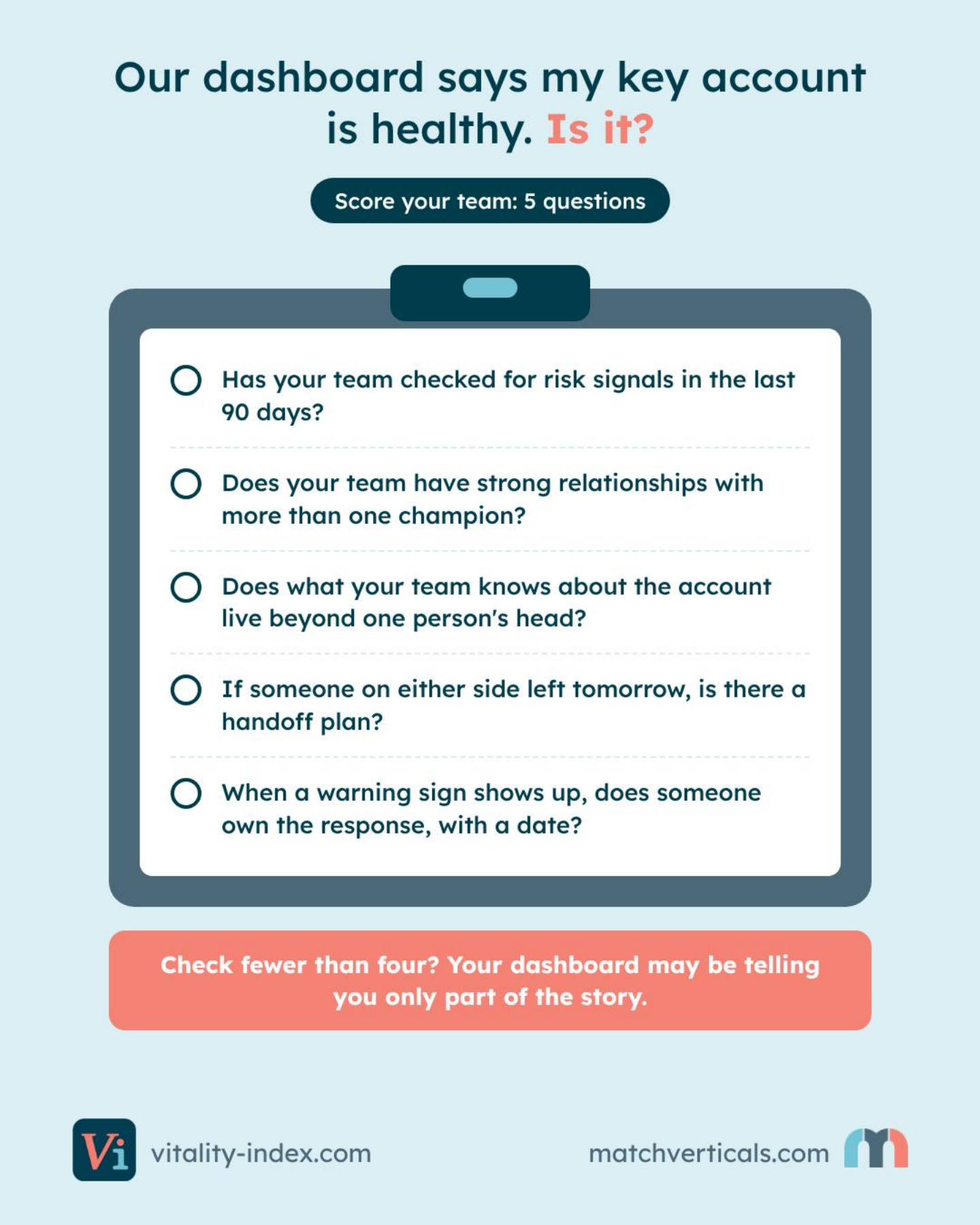
Five questions to see if your team can do this job today:
- Has your team checked for risk signals in the last 90 days, such as a champion changing roles, a new procurement leader, a budget shift or a competitor meeting their executives?
- Does your team have strong relationships with more than one champion, across functions and levels?
- Does what your team knows about the account live somewhere other than one person's head?
- If someone on either side left tomorrow, is there a plan for the handoff?
- When a warning sign shows up, does someone own the response, with a date?
Two or more no's, and your dashboard may be telling you only part of the story.
One of our key accounts was spending about $10M a year with us, and on the surface, nothing looked wrong. Our champion had referred us across departments for years. Then a few small opportunities went to a competitor. We tracked our share of the account every month, so we saw it slip early. We asked our champion what had changed. A board member with a personal tie to the competitor's owner had brought them in, and she had been asked to give them a fair look. We had no access to that board member. So we gave our champion what she needed to defend us: our performance metrics, satisfaction scores and measurable results, in a format she could share with her leadership. We expanded into departments where we had no presence, refreshed our pricing, and brought enterprise-level outcomes to every quarterly business review. We held our market share, and the competitor's foothold stayed small.
Performance earns the right to compete. Your team can see what's changing inside the account by watching share, people and signals, along with the totals.
Our system, the Vitality Index, gives your key account teams the strategy and the plan, and shows them what to execute across 21 growth drivers, including status with champion, account intel and account team collaboration. It shows where they stand today, the work it takes to level up, and how to do it, until they reach a vital partnership that lasts.
What would your largest customer tell you about your partnership that your dashboard doesn't?
We built a free, 4-minute Key Account Risk Assessment. It gives you a risk score for your key accounts across team alignment, account planning, account transitions, and visibility. Link in the comments.
More in LinkedIn Posts
LinkedIn Posts
Would my champion in our key account be proud to forward our results to their boss?
A champion forwards what makes them look good to their boss and poses no risk of hurting their brand.
LinkedIn Posts
I need my partners and sub-vendors running the same strategy for my key account that we are.
Partners and sub-vendors shape how the client experiences your team.
LinkedIn Posts
I need my team to act on warning signs at my key account before they turn into losses.
Warning signs often show up early: a number that slips, a meeting that gets pushed, a champion who goes quiet.
LinkedIn Posts
I need proof of what we deliver for my key account, captured while we deliver it.
When the client asks what you've done for them, the answer needs numbers in their language.
LinkedIn Posts
I need sales and delivery to turn their disagreements into progress on my key account.
Sales and delivery often disagree on how to approach the work in key accounts that are growing.
LinkedIn Posts
I need someone on my team who could run my key account tomorrow.
In key account management, it's critical to have a succession plan.
Related across the blog
Strategy & Planning
CRM vs. Account Planning Tools vs. a Key Account Growth System: What Each One Does
A CRM keeps the records. Account planning tools structure the plan your team fills in. A key account growth system generates the strategy itself. Here is the difference, side by side.
Key Account Systems
The structure behind growing key accounts in B2B needs changing
Growing key accounts takes more than records and tools. Explore the strategic layer account teams need and the nine standards behind the Vitality Index.
Key Account Growth
You just won a massive key account. Now what?
Winning a massive key account is only the start. The real work is building a partnership that can withstand renewals, competitive threats, and growth across the business.
Lead with better systems.
The same frameworks that power this post power Vitality Index - the platform strategic account teams use to measure, plan, and grow their most vital partnerships.