
LinkedIn Posts
Why does each key account manager on my team forecast a different way?

When each key account manager (KAM) forecasts their own way, the team's number is built with different rulers.
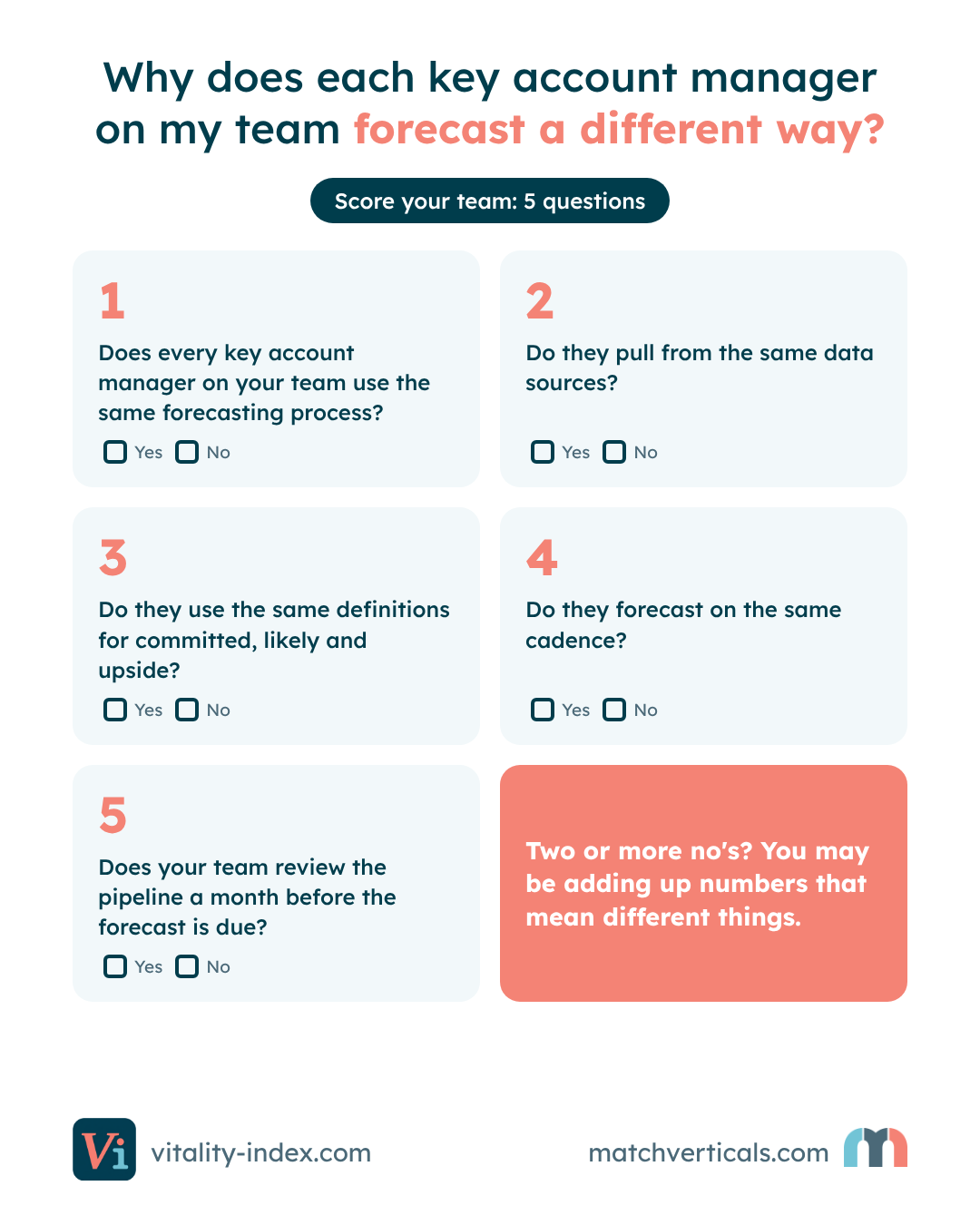
Why does each key account manager on my team forecast a different way?
When each key account manager (KAM) forecasts their own way, the team's number is built with different rulers. One process, the same data sources, the same definitions and the same cadence let you add the numbers up and trust the total.
Five questions to see if your team can do this job today:
- Does every KAM on your team use the same forecasting process?
- Do they pull from the same data sources?
- Do they use the same definitions, such as what counts as committed, likely or upside?
- Do they forecast on the same cadence?
- Does your team review the pipeline a month before the forecast is due?
Two or more no's, and you may be adding up numbers that mean different things.
I've run a team of 50 or more account managers on one account. Each year, we spent a considerable amount of time on forecasting, and each time felt different. Sometimes that was due to an evolving process. Other times it was because new team members knew less about the side of the customer they supported. When we finally standardized our approach and built a good system, we got it done in less time with better results.
A good forecast is a good theory about what causes revenue to increase or decrease. Over time, the theory is proven or disproven. So we set out to get better at creating good theories. That means everyone can contribute and think of questions we should answer to test our theory against where we stand today, what it will take to hit the forecast, and what could change tomorrow that would change our theory.
Your team can start by agreeing on one process and the questions every KAM answers before a number goes in.
Our system, the Vitality Index, shows your key account teams where they stand today, the work it takes to level up, and how to do it, until they reach a vital partnership that lasts.
If you asked three of your KAMs what "committed" means, would you get the same answer?
We built a free, 4-minute Key Account Risk Assessment. It gives you a risk score for your key accounts across team alignment, account planning, account transitions, and visibility. Link in the comments.
More in LinkedIn Posts
LinkedIn Posts
Would my champion in our key account be proud to forward our results to their boss?
A champion forwards what makes them look good to their boss and poses no risk of hurting their brand.
LinkedIn Posts
I need my partners and sub-vendors running the same strategy for my key account that we are.
Partners and sub-vendors shape how the client experiences your team.
LinkedIn Posts
I need my team to act on warning signs at my key account before they turn into losses.
Warning signs often show up early: a number that slips, a meeting that gets pushed, a champion who goes quiet.
LinkedIn Posts
I need proof of what we deliver for my key account, captured while we deliver it.
When the client asks what you've done for them, the answer needs numbers in their language.
LinkedIn Posts
I need sales and delivery to turn their disagreements into progress on my key account.
Sales and delivery often disagree on how to approach the work in key accounts that are growing.
LinkedIn Posts
I need someone on my team who could run my key account tomorrow.
In key account management, it's critical to have a succession plan.
Related across the blog
Sales Leader Insights
Research Says CROs Miss Forecast by More Than 10%, Nearly 80% of the Time. Here's What Keeps That From Being Your Story.
Nearly 80% of sales organizations miss their forecast by more than 10%. The research shows where the more predictable number actually lives, and three shifts that change the outcome.
Strategy & Planning
CRM vs. Account Planning Tools vs. a Key Account Growth System: What Each One Does
A CRM keeps the records. Account planning tools structure the plan your team fills in. A key account growth system generates the strategy itself. Here is the difference, side by side.
Key Account Systems
The structure behind growing key accounts in B2B needs changing
Growing key accounts takes more than records and tools. Explore the strategic layer account teams need and the nine standards behind the Vitality Index.
Lead with better systems.
The same frameworks that power this post power Vitality Index - the platform strategic account teams use to measure, plan, and grow their most vital partnerships.